Dubai · Web Development
Web development services in Dubai — built to be handed over.
Custom builds, WordPress, storefronts and web applications, written so the next developer can read them — and delivered with the repository, the documentation and every account already in your name.
- You own the repository
- Fixed scope, fixed price
- Dubai-based engineers
What this covers
Four things happen in every build, whatever the platform.
The technology changes between projects. This does not — and it is the part that decides what the site costs you in year two.
The front end
Markup, styling and interaction built from the design at every breakpoint — keyboard reachable, semantically structured and measured against a performance budget agreed before the first commit.
Content and commerce
WordPress, Shopify or headless, with the content modelled properly: editors get components they can arrange and cannot break, instead of a blank page and a builder plugin.
Applications and integrations
Logins, roles, records and workflows where the requirement is software rather than pages — and the APIs that join the site to the CRM, ERP, payment and logistics systems already in use.
Launch and handover
Environments, redirects, analytics and search console, then the repository, a README and a walkthrough. Every account in your name, so leaving requires no negotiation.
Development services
What we build, and where each one fits.
Each has its own page — what is included, how it is delivered and what you receive at the end. If two of them look close from here, the comparison underneath separates them.
Bespoke builds for businesses whose requirements a theme cannot meet — modern framework, typed codebase, documented and handed over.
You receiveCustom build + repository access
Custom themes and blocks written by hand, not assembled in a page builder — so editors get flexibility without the performance penalty.
You receiveCustom theme + editor training
Storefronts wired into the payment gateways, delivery partners and VAT rules that UAE retail actually runs on, not generic defaults.
You receiveLive store + operations handbook
Custom Shopify themes, app integrations and platform migrations, including catalogue transfers that preserve URLs and search rankings.
You receiveCustom theme + migration
Client portals, booking systems, dashboards and internal tools — the software that sits behind the marketing site and runs the business.
You receiveApplication + technical documentation
Finished designs converted into production front-end code — HTML and CSS, a WordPress theme, a React build or a Shopify theme.
You receiveResponsive, accessible front-end code
Joining the site to the systems around it — CRM, ERP, accounting, payment and logistics — so data stops being retyped by hand.
You receiveIntegration + monitoring
iOS and Android applications, native or cross-platform, sharing an API and a design system with the website they sit alongside.
You receivePublished apps + release pipeline
How to choose
WordPress, custom, or something that is not a website at all.
The platform decision has the longest tail of anything you choose: it sets what every future change costs. Where a cheaper option genuinely fits, that is the one we will recommend — including the ones that earn us less.
| Option | When it fits | When it does not |
|---|---|---|
| WordPress | Your team publishes regularly and the requirements are conventional — pages, posts, campaigns, a careers section, a few forms. It is cheaper to build, cheaper to run, and far easier to staff later. | The moment the site has to do something rather than say something — accounts, roles, calculations, live data from another system — you are bolting plugins onto a publishing tool and paying maintenance on all of them. |
| Custom development | The requirement has no off-the-shelf shape: an unusual content model, a calculator, strict performance targets, or an integration no plugin covers. What you are buying is the absence of a ceiling. | For a five-page brochure site it is the wrong purchase — you would pay for flexibility you never use. We say so rather than sell it: WordPress fits, costs less, and is easier for you to hire against. |
| Shopify | You sell physical products and would rather not own the infrastructure. Payments, checkout, security and the app ecosystem come with the platform, and we shape the theme, the catalogue and the integrations around your brand. | When the checkout itself has to behave differently from what the platform permits, or the commercial rules are deep enough that they belong in a system you control, the platform becomes a constraint rather than a shortcut. |
| Your own store | The store has to live inside your stack: B2B or contract pricing, stock and orders synced to an ERP, unusual VAT or delivery rules, or a catalogue that is one part of a much larger content site. | For a straightforward consumer catalogue it means owning your own payments, security patching and uptime. A hosted platform does all three for a monthly fee, and does them well. |
| A web application | The real requirement is not a website. Logins, roles, records, approvals, a booking flow, a dashboard — a process currently held together by spreadsheets, WhatsApp and re-typing. | If a form and a notification would solve it, build that first. An application is a system somebody has to run, and it only earns its keep once the process behind it is genuinely repeated. |
| Integration work | The systems already exist and people are retyping between them — site, CRM, accounting, payment gateway, courier. The work is joining them, handling the failures, and monitoring the join afterwards. | Not as a first move while the underlying process is still unsettled. Automating something nobody agrees on only makes the disagreement faster, and every integration is one more thing to maintain. |
| A finished design | The design is finished and signed off — yours, an in-house designer's, or another studio's — and what you need is an accurate, responsive, accessible build of it in HTML, WordPress, React or a Shopify theme. | If the design is still moving, or the states, breakpoints and empty screens were never drawn, building first is the expensive order to do things. Resolve the design, then hand it over. |
| A mobile app | Usage is repeated and personal, and you need what a browser will not give you: push notifications, offline use, camera or location access, a place on the home screen. | For something people use once or twice a year, a fast responsive site reaches them with no install at all. An app nobody reopens still has to be released, tested and kept current with every OS update. |
How we build
Five phases, and nothing is a surprise at the end of one.
A development project goes wrong quietly, in the weeks nobody sees. Every phase here ends with something you can open, run or argue with.
01
Technical discovery
Requirements, constraints and the systems you already run. What the last site could not do, what has to migrate, which languages, which integrations. It ends in a written scope with a fixed price against it.
02
Architecture
URL structure, content model, data model, environments — and the stack decision written down with the reasoning, while it is still cheap to disagree with it.
03
Build in the open
Weekly increments on a staging URL you can visit whenever you like. Typed code, reviewed before it merges, kept inside the performance budget rather than profiled against it at the end.
04
QA and migration
Browsers and real devices, keyboard and contrast checks, forms and integrations exercised end to end, content moved across and every old URL mapped to a new one before anything goes live.
05
Launch and handover
Go-live checklist, analytics and search console connected, then the repository, the documentation and a recorded walkthrough. After that you either run it or we do, on a care plan — never because you have no alternative.
Stack
Boring technology, chosen so the next developer recognises it.
Nothing here is exotic. That is the point: an unusual stack is a lock-in mechanism dressed up as innovation.
- Front-end
- Next.jsReactTypeScriptTailwind CSSAstro
- CMS & commerce
- WordPressShopifySanityPayloadWooCommerce
- Back-end & data
- Node.jsPostgreSQLLaravelRedisPrisma
- Infrastructure
- VercelAWSCloudflareGitHub ActionsSentry
Proof
Live work, open to inspection.
Public sites we designed and built. Open one and judge the work, not the claim.
 Food & beverage
KOA Eatery (opens in a new tab)
A specialty coffee house in Oman, where the site carries the room rather than a catalogue — sourcing and craft up front, and QR ordering that has to work one-handed at a table, on a phone, on café wifi.
- Next.js
- Vercel
 Fintech
Ladoo.AI (opens in a new tab)
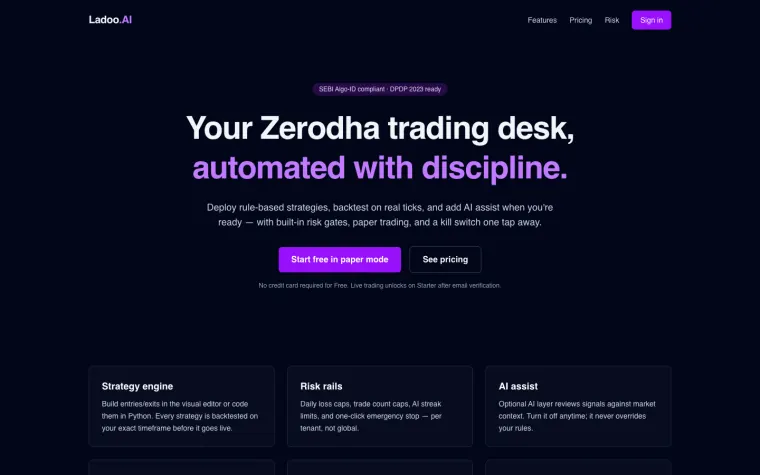
A rule-based trading desk on top of Zerodha: visual and Python strategy building, backtesting on real ticks, and an optional AI layer that reviews signals but never overrides the rules. Risk rails and a one-tap kill switch are product features, not settings.
- Next.js
- Cloudflare
- Razorpay
Pricing
What a build actually costs.
AED 16,000
from
A conventional WordPress or custom marketing site starts here. The main commercial site for an established business is typically AED 48,000, and applications, portals and larger stores start at AED 95,000. Prices exclude 5% VAT, and payment runs in milestones.
What changes the priceWhat that covers
- A written scope agreed before anything starts
- The repository, in your account, from the first commit
- A performance budget enforced through the build
- Redirects, analytics and search console at launch
- Documentation, editor training and a handover walkthrough
Related
The rest of what we do.
Two disciplines and the care plan that keeps the result alive. This page covers one of them.
Questions
The questions worth asking before you sign anything.
You do, and it lives in your account. The repository is created under your organisation before the first commit rather than transferred at the end, and the same applies to hosting, domain, analytics and design files. There is no proprietary framework, no licence you have to keep renewing through us, and nothing to buy back if you leave.
That is the standard we build to. Conventional stack, typed code, no page-builder markup, a README that explains how to run it and a walkthrough recorded at handover. If picking the project up requires an archaeology exercise, we have failed the brief regardless of how the site looks.
Requirements first, then the most ordinary technology that meets them. An unusual stack is a lock-in mechanism dressed as innovation — the next developer has to recognise what they are looking at. The choice is written down with its reasoning during the architecture phase, so you can disagree with it while changing it is still free.
Not for the build. A page builder gives an editor freedom to break the layout, adds weight to every page, and stores your content in a form only that plugin fully understands. We build custom blocks in the WordPress editor instead: editors get the components the design actually contains, arranged how they like, and nothing they can wreck.
Six weeks is typical for a marketing site from kick-off, and nine to sixteen for larger builds. Applications and portals are scoped individually. What extends a project is almost never the code — it is content that is not written, approvals with no named approver, and integrations where nobody can get us API access.
Usually. CRM, ERP, accounting, payment gateways and logistics providers are routine work, and the site is often the thinnest part of it. What we need before quoting is documentation, a test environment and credentials — if a vendor will not provide an API, that constraint has to shape the scope rather than be discovered halfway through the build.
Nothing improvised. Redirects are mapped and tested on staging, DNS is prepared in advance, analytics and search console are connected before go-live rather than after, and the performance budget is checked one last time against the real thing. Launch is a checklist worked through with you, not an event you are told about afterwards.
Nothing breaks and nothing is withheld. The accounts are already yours, the code is already in your repository and the documentation is already written, so the handover is a conversation rather than a project. There is no export fee, no final invoice for access, and no password anyone has to wait on us for.
Ready to build something that lasts?
Tell us what you need. You will get a scoped response with an indicative price — from an engineer, not a salesperson.